
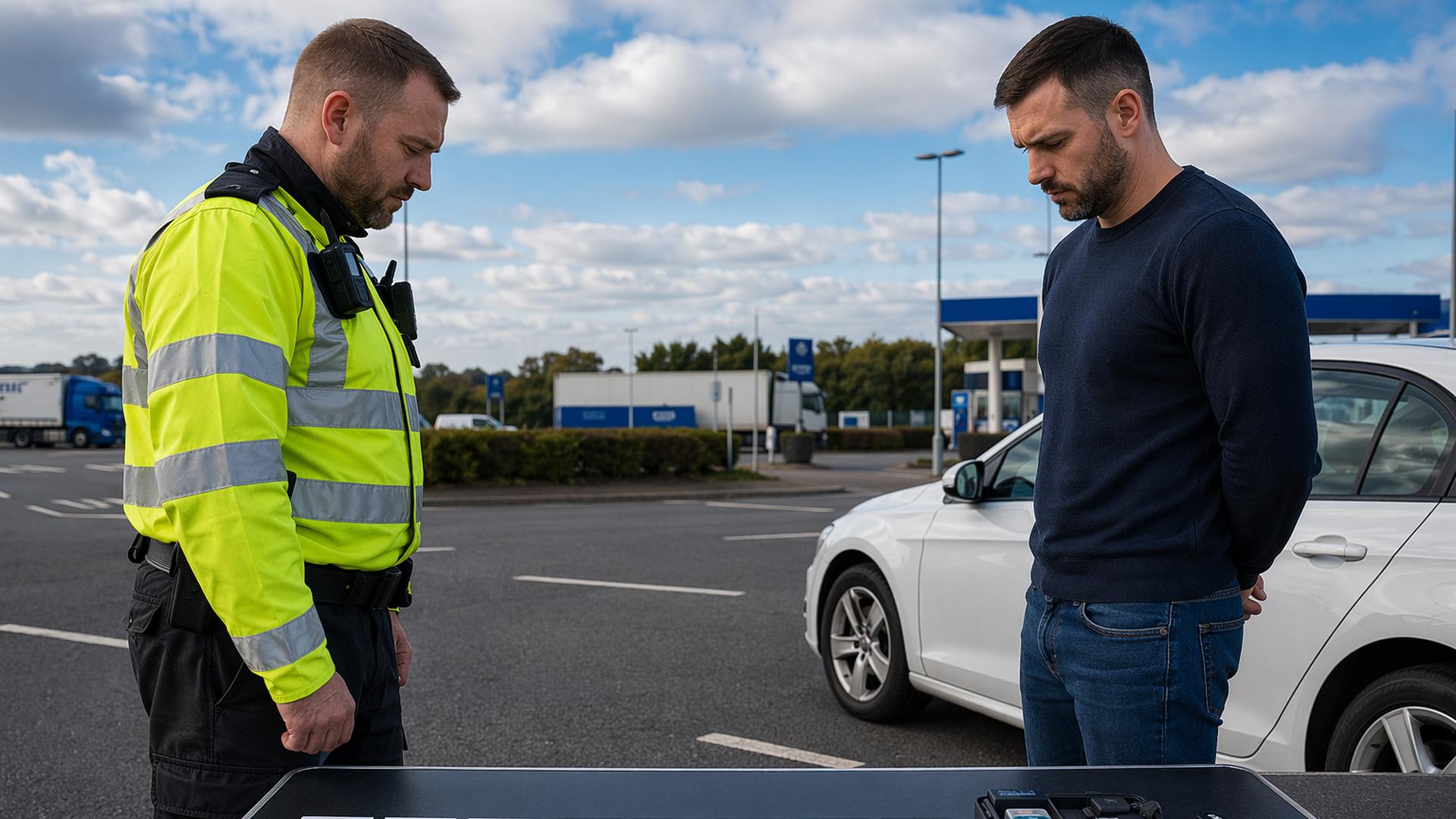
7 Steps That Follow a Failed Roadside Drug Test in the UK
Published by Drug Driving Solicitors, specialist defence lawyers for drug driving charges across England and Wales.
If a police officer stops you on suspicion of drug driving in England or Wales, events can move very quickly. Understanding what happens at each stage can be the difference between being caught off guard and being properly prepared. From the moment a screening device is placed in front of you to the point at which a court delivers its verdict, there is a defined legal process, and knowing it matters.
This article walks through the seven key stages that follow a failed roadside drug test. Whether you are personally affected or simply want to understand how drug driving law operates in practice, the information below gives a clear, honest account of what to expect at each turn.
Step 1: The Officer Administers a Statutory Warning
Why the Warning Must Come First
Before a police officer can require you to provide a sample for a roadside drug screening test, they must first administer a statutory warning under Section 6(7) of the Road Traffic Act 1988. This warning informs you that failing to cooperate with the test is itself a criminal offence. The requirement is not a mere formality; it is a legally prescribed step, and any failure on the officer's part to deliver it correctly can have significant consequences for the case that follows.
The warning must be delivered clearly and in full. Officers are trained to administer it in precise terms, and many forces use a printed card to ensure consistency. If English is not your first language, or if you have a medical condition that affects your comprehension, those factors may become relevant later in proceedings. At this stage, however, the important thing to understand is that you are entering a formal legal process the moment the officer speaks those words.
What You Should and Should Not Do
At the point of the statutory warning, your conduct matters. You are legally required to cooperate with the screening test if the officer has reasonable grounds to suspect drug use. Refusing without a reasonable excuse is a criminal offence carrying the same potential penalties as a drug driving conviction. Many people are surprised to learn that the threshold for reasonable grounds is relatively low and can include observations such as erratic driving, slurred speech, or dilated pupils.
What you say at this stage can also become relevant in court. You are not obliged to answer questions beyond providing your name and address, and anything you do volunteer may be recorded. The wisest course of action is to cooperate with the test itself while remaining measured in what you say. Contacting a specialist solicitor at the earliest opportunity, ideally while still at the roadside if circumstances allow, gives you the best footing going forward.
Step 2: The Roadside Device Produces a Positive Reading
How Roadside Drug Testing Works
The device used at the roadside is known as a type-approved drug screening device. In England and Wales, the Dräger DrugTest 5000 and the Securetec DrugWipe 5S are among the devices currently approved for police use. Each device tests for specific controlled substances, and the approval of a device is drug-specific, meaning a device approved to screen for cannabis is not necessarily approved to screen for cocaine. This distinction is more important than many people realise.
A positive reading from a type-approved device does not constitute proof of a drug driving offence. It is a screening result, not a confirmation. The device is calibrated to detect the presence of certain substances above a particular threshold, but it is not infallible. Environmental contamination, passive exposure, and certain medications can all produce unexpected readings. The roadside result is the starting point of a process, not the conclusion of one.
The Significance of a Positive Screening Result
When the device returns a positive reading, the officer will typically inform you of the result and explain what will happen next. At that point, the investigation moves from suspicion to a more formal stage. The positive screening result gives the officer grounds to proceed further, including grounds for arrest. Understanding the distinction between a screening result and a confirmed analytical result is central to understanding your legal position.
It is also worth noting that the offence created under Section 5A of the Road Traffic Act 1988 is what lawyers describe as a strict liability offence at the blood analysis stage. This means that once a controlled drug is found above the specified limit in a blood sample, the prosecution does not need to prove impairment. The roadside screen is therefore the first step towards a process with serious legal consequences, and it deserves to be treated with appropriate seriousness from the outset.
Step 3: You Are Arrested and Taken to a Custody Suite
The Arrest and Its Immediate Consequences
Following a positive roadside screening result, the officer will almost certainly arrest you on suspicion of a drug driving offence. The arrest will be made under Section 6D of the Road Traffic Act 1988, which permits an officer to arrest a person who has provided a positive specimen at the roadside. You will be cautioned at the point of arrest using the standard wording, and your rights will be explained to you. The vehicle you were driving will typically be secured or recovered, and you will be transported to the nearest designated custody suite.
Arrival at the custody suite begins a distinct phase of the process. You will be booked in by a custody sergeant, who must independently review the grounds for your detention and authorise it. Your personal belongings will be recorded and stored. You have the right to have someone informed of your arrest, and you have the right to consult a solicitor free of charge and in private before any further samples are taken. Exercising that right is strongly advisable.
Your Rights in Custody
One of the most important rights available to you in custody is the right to free and independent legal advice. This is provided through the duty solicitor scheme at no cost to you. You can request the duty solicitor or, if you already have a solicitor in mind, contact them directly. A solicitor can advise you on the process, on what to say and what not to say, and on whether any aspect of the procedure carried out so far appears to have been conducted incorrectly.
You will also be asked whether you have any medical conditions and whether you are taking prescribed medication. Answer these questions honestly, as the information is directly relevant to the next stage of the process. The custody environment can be disorientating, particularly if it is your first encounter with it. Taking legal advice before anything further happens is not a sign of guilt; it is the sensible exercise of a right that exists precisely for situations like this one.
Step 4: A Healthcare Professional Takes a Blood Sample
The Role of the Healthcare Professional
Once you are in custody, a healthcare professional, typically a forensic physician or a nurse with the appropriate authorisation, will be called to take a blood sample. The officer cannot take the sample themselves; the law requires it to be taken by a suitably qualified medical practitioner. You will be offered the opportunity to speak to a solicitor before the sample is taken, and you should take that opportunity if you have not already done so.
The healthcare professional will assess whether any medical reason exists that would prevent a blood sample from being taken. If there is a genuine medical reason, the officer may require a urine sample instead, though this is less common in drug driving investigations. The professional will explain the procedure to you and you will be asked to confirm that you have no medical objection to the taking of a blood sample. If you have any concerns, raise them clearly and ask for them to be noted in the custody record.
Your Right to a Portion of the Blood Sample
A feature of the process that many people are unaware of is the right to receive a portion of their own blood sample. The sample is divided into two parts, and you are entitled to keep one. This is important because it enables you to instruct an independent laboratory to carry out its own analysis, which can then be compared with the results of the police laboratory. Discrepancies between the two analyses have featured in successful defences, and having an independent result available gives a specialist solicitor considerably more to work with.
If you are not offered your portion of the sample, raise this with your solicitor immediately. Failure to offer the divided sample is a procedural irregularity that can, in appropriate circumstances, affect the admissibility of the evidence or the overall strength of the prosecution's case. Keep any documentation you are given about the sample, including the reference number on the container, somewhere safe.
Step 5: The Blood Sample Is Sent for Laboratory Analysis
What Happens to the Sample
After the blood sample is taken and divided, the officer's portion is sealed, labelled, and placed into a secure chain of custody for delivery to the force's nominated forensic laboratory. The integrity of that chain of custody is a matter of legal significance. Each stage of the sample's journey must be properly documented, and any break in the chain, or any failure to store the sample in the correct conditions, can be raised as a challenge to the reliability of the analysis.
The laboratory carries out a detailed analytical process to identify whether any controlled drugs are present in the sample and, if so, at what concentration. The substances tested include those covered by the drug driving legislation, each of which has a specified limit expressed in micrograms per litre of blood. The analysis typically uses techniques such as gas chromatography-mass spectrometry, a widely regarded and reliable method, though one that is not entirely immune to error. The laboratory will produce a formal report setting out its findings in full.
The Waiting Period and What It Means
The period between the blood sample being taken and the laboratory report being received is typically the longest single stage in the entire process. It is not unusual for this to take anywhere from several weeks to several months, depending on the workload of the laboratory in question. During this time, you will not necessarily hear anything from the police or the Crown Prosecution Service. This silence can be unsettling, but it does not indicate that the matter has been dropped.
If you have retained your portion of the divided sample, arrange for it to be independently analysed during this waiting period. An independent analysis should be commissioned promptly, as blood samples degrade over time. Your solicitor can help identify a suitable accredited laboratory and ensure the independent analysis is carried out in a way that produces reliable, admissible results. Being armed with independent evidence before the police receive their own report puts you in a considerably stronger position.
Step 6: You Are Charged or Told No Further Action Will Be Taken
How the Charging Decision Is Made
Once the laboratory report is received, it is reviewed by the investigating officer and, in most cases, submitted to the Crown Prosecution Service for a charging decision. The CPS applies the two-stage test from the Code for Crown Prosecutors: first, whether there is sufficient evidence to provide a realistic prospect of conviction; and second, whether prosecution is in the public interest. In drug driving cases where a laboratory confirms a controlled drug above the specified limit, both limbs of that test are almost always satisfied, and a charge typically follows.
You will usually be notified of the charge either by being asked to return to the police station or by receiving a postal requisition. The charge will specify the offence under Section 5A of the Road Traffic Act 1988, or in some cases under the older Section 4 offence if impairment rather than an excess drug level is the basis of the prosecution. The charge document will include a date for your first court appearance. Read it carefully and contact your solicitor as soon as you receive it.
When No Further Action Is Taken
In some cases, the laboratory results either do not confirm the presence of a controlled drug above the specified limit, or reveal another reason why the prosecution cannot properly proceed. In those circumstances, you will be informed that no further action will be taken. This is always welcome news, but it does not always mean the process has been without consequence. An arrest will have been recorded, and the investigation will remain on file.
There are also cases in which a solicitor's early intervention, drawing the officer's attention to procedural errors or evidential weaknesses before the charging decision is made, contributes to a no-further-action outcome. This is one of the reasons why seeking specialist legal advice at the earliest possible stage, rather than waiting to see whether a charge arrives, can make a genuine difference to the overall outcome.
Step 7: Your Case Is Heard at the Magistrates' Court
What Happens at Court
Drug driving offences under Section 5A of the Road Traffic Act 1988 are summary offences, which means they are dealt with in the Magistrates' Court rather than the Crown Court. Your first appearance is likely to be a short administrative hearing at which you will be asked to enter a plea. If you plead guilty, the case may proceed to sentence at the same hearing or be adjourned for a pre-sentence report. If you plead not guilty, a trial date will be set, typically several weeks or months later.
The Magistrates' Court deals with drug driving cases regularly, and the proceedings, while formal, are designed to be accessible. You will be represented by your solicitor or, if you have instructed a barrister, by counsel. The prosecution will be presented either by a Crown Prosecution Service advocate or a police prosecutor. The magistrates, usually three lay members or a single district judge, will hear the evidence and deliver a verdict.
Sentencing and the Road Ahead
A conviction for a Section 5A drug driving offence carries a mandatory minimum penalty of a 12-month driving disqualification. There is no discretion on this point; the ban is automatic upon conviction. In addition, the court may impose a fine, a community order, or in more serious cases a custodial sentence. The offence will be recorded on your driving licence as a DG10 endorsement for 11 years, and insurance premiums are likely to increase significantly upon licence restoration.
A not-guilty verdict, by contrast, results in an acquittal and the return of your licence if it was surrendered. The outcome of proceedings in the Magistrates' Court is not predetermined simply because a laboratory result exists. Experienced defence solicitors identify weaknesses in the prosecution's case, challenge evidence at trial, and engage with the CPS where appropriate. At every stage from the roadside to the court room, specialist legal representation gives you the best prospect of the best possible outcome.
Understanding What This Process Means for You
Knowing the seven stages that follow a failed roadside drug test does more than satisfy curiosity. It shows you where the pressure points in the process lie, where things can go wrong for the prosecution as well as for the accused, and at which stages your own choices carry the most weight. The process is not a conveyor belt that moves only in one direction; it is a legal procedure governed by rules that must be properly followed by everyone involved, including the officers and laboratories handling your case.
Frequently Asked Questions
What are the most common reasons drug driving charges are dropped?
The most frequent grounds include failure to administer the statutory warning correctly before requiring the roadside swab; use of a device that was not type-approved for the drug in question; problems with the blood sample chain of custody; failure to offer the defendant their portion of the blood sample; errors in laboratory analysis; and an unlawful stop and search. A specialist solicitor will review all of these as a matter of course rather than focusing only on the headline blood test result.
What happens if I refuse to give a blood sample at the custody suite?
Refusing to provide a specimen without a reasonable excuse is itself a criminal offence under Section 7A of the Road Traffic Act 1988, carrying the same penalties as a drug driving conviction, including the mandatory 12-month disqualification. Reasonable excuses are very narrowly defined, and any medical reason must be supported by evidence. You should never refuse without first speaking to a solicitor.
Will a drug driving conviction affect my ability to travel abroad?
A conviction can create complications for international travel. Entry to countries such as the United States, Canada, and Australia may be affected, as immigration authorities in those jurisdictions routinely ask about criminal convictions. Even a conviction that is considered spent under the Rehabilitation of Offenders Act 1974 may need to be disclosed when applying for a visa or Electronic Travel Authorisation to certain countries. If travel is important to you professionally or personally, the potential impact on your ability to travel should form part of your discussion with a specialist solicitor before you decide how to proceed with your case.
What if the drug found in my blood was prescribed by my doctor?
A statutory medical defence exists under Section 5A(3) of the Road Traffic Act 1988 for drivers who can show that the drug was prescribed or supplied to them, that they took it in accordance with medical advice, and that their driving was not impaired. The defence is available but narrower than many people assume; it must be properly evidenced and clearly presented. Drug Driving Solicitors has specific expertise in drug driving cases involving prescription medication.
How long does it take from failing a roadside drug test to being charged?
The process typically takes between two and six months, though it can be longer. The principal source of delay is the laboratory analysis of the blood sample, which depends on the force's nominated laboratory and its current workload. Once the laboratory report is received, the charging decision is usually made relatively quickly. If you have not heard anything within six months of the incident, seek specialist legal advice on your position.
What is a DG10 and how long does it stay on my licence?
DG10 is the DVLA offence code for driving or attempting to drive with a controlled drug above the specified limit, the standard Section 5A offence. It is recorded on your driving licence for 11 years from the date of conviction and is visible to any insurer who checks the DVLA database. Insurance premiums typically increase significantly following a DG10 conviction. A specialist solicitor can advise on the full implications of a DG10 for your specific circumstances, including employment and travel considerations.
Drug Driving Solicitors is a specialist law firm representing clients in drug driving cases throughout England and Wales. If you have failed a roadside drug test and want to understand where you stand, contact us for a free initial consultation or visit drugdrivingsolicitors.co.uk. Getting early advice costs nothing and can make all the difference to how your case is resolved.